
Dry-ice transport box: EPS foam or rotomoulded plastic?
Insulation, lifetime, CO₂ footprint and total cost — when the switch from EPS to reusable plastic pays off.
EPS boxes are dirt cheap per unit but single-use — every shipment creates packaging waste and requires replacement stock.
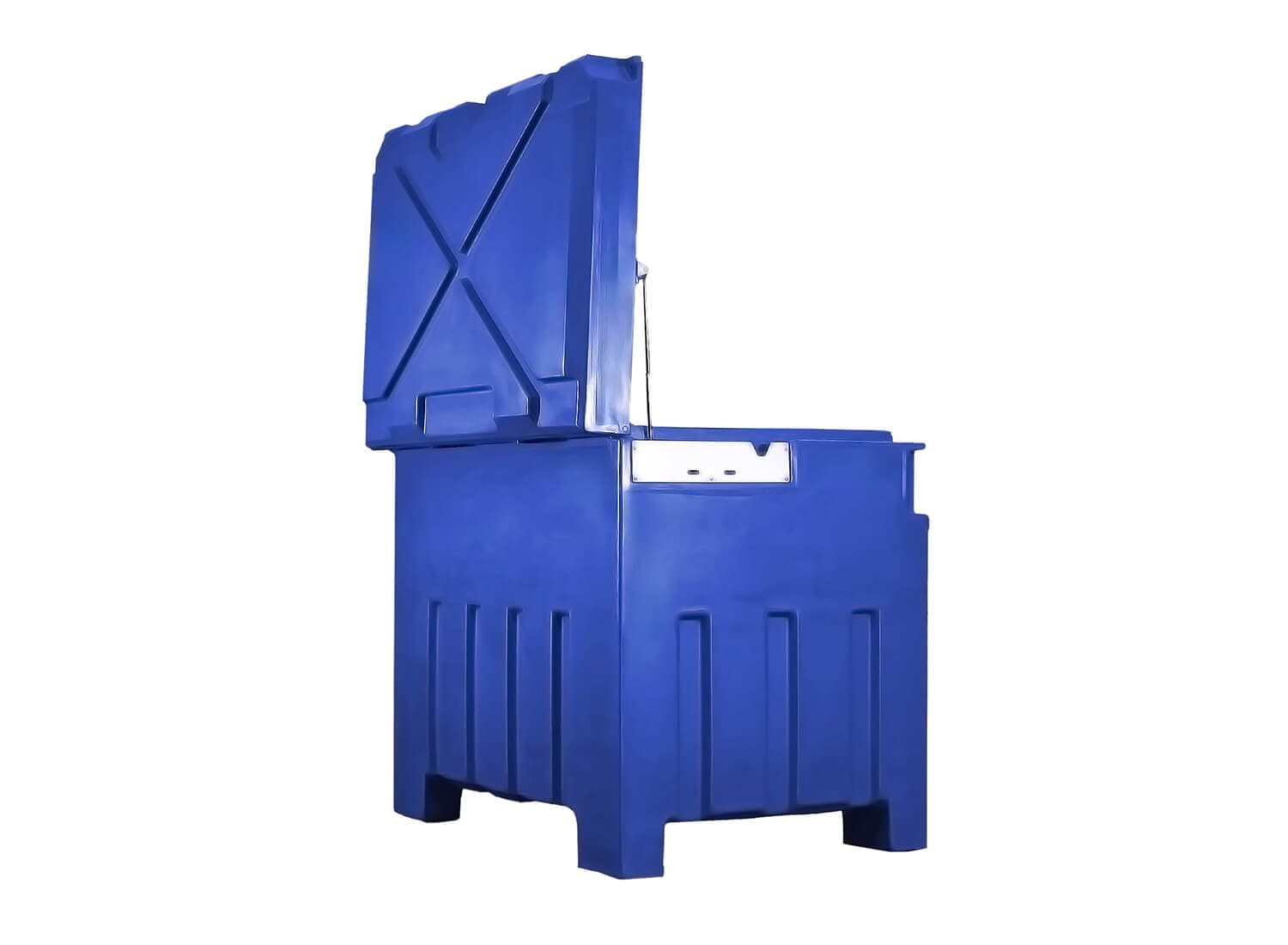
Rotogal rotomoulded PE dry-ice boxes hold dry ice reliably for 5–7 days instead of 2–3.
Over 200 trips per box the higher upfront cost amortises many times — with measurable CO₂ savings on top.
Insulation: why material is the deciding factor
Dry ice sublimates at −78.5 °C. The craft is in holding that temperature over the transport window while keeping CO₂ mass loss low.
EPS has good thermals but weak structure: impacts, moisture and deformation translate directly into insulation loss. Our rotomoulded multi-chamber walls hold insulation flat — even after years in rough logistics environments.
Lifecycle and CO₂ footprint
Single-use EPS carries a significant CO₂ load per shipment. Our PE boxes require more energy to produce, but that extra load is amortised after 15–25 shipments. From then on every trip is a net CO₂ saving.
At end of life we take the box back and recycle the PE fully back into the loop.
Handling and hygiene
EPS is porous and absorbent — once contaminated (e.g. in pharma shipping) the box can't be cleaned economically. PE boxes are closed and get validated cleaning between cycles.
For GMP shipping that's a hard qualification advantage: the box is part of the validated packaging system, not a single-use consumable outside it.
EPS vs. Rotogal dry-ice box
| EPS / foam | Rotogal box | |
|---|---|---|
| Usage | Single-use | Reusable (200+ cycles) |
| Dry-ice insulation | 2–3 days | 5–7 days |
| Mechanical toughness | Brittle | Very high |
| Cleaning | Not feasible | CIP / high-pressure |
| GMP qualifiable | Difficult | Yes |
| Break-even | — | ~ 15–25 shipments |
| End of life | Waste | PE recycling |
For rare shipments
EPS may still pay off with a handful of transports per year — pooling lowers that threshold.
For regular shipping
Reusable plastic is economically and ecologically superior — especially in pharma and GMP.
For international pharma
Only reusable PE is validatable and traceable — EPS is practically out.

Frequently asked questions
How many cycles does a Rotogal dry-ice box last?
Our customers routinely hit 200 to 400+ cycles. Handling, return rate and cleaning are the deciding factors — we're happy to help you set up the logistics loop.
Are temperature-monitored variants available?
Yes — we integrate RFID, Bluetooth loggers and dedicated cavities for calibrated data loggers. The box becomes part of your GDP monitoring concept.
Are the boxes airfreight-compatible?
Yes. Our dry-ice boxes are shaped and ventilated per IATA Dangerous Goods Regulations (UN1845).
Do you offer return and cleaning as a service?
Yes — we run return logistics in cooperation with our customers. Get in touch and we'll size the loop with you.
Got a project?
Tell us about your requirement — we typically come back with a first assessment within 24 hours.
More guides
Please note: All information on this page – in particular dimensions, technical data, material properties and application recommendations – is provided for general guidance only and is non-binding. The exact specifications tailored to your specific application are agreed on a binding basis as part of the quotation and order process.
Got a project?
Tell us about your requirement — we typically come back with a first assessment within 24 hours.