
Food industry
Hygiene that proves itself with every cleaning cycle.
In slaughterhouses, cutting plants, dairies, bakeries and commercial kitchens, hygiene, cleanability and chemical resistance determine product safety and operating hours. Rotogal has delivered seam-free, food-grade containers and pallets for decades — reliable under high-pressure cleaning, aggressive detergents and temperature swings from −30 °C to +70 °C.
Deep-freeze capable without embrittlement
High-pressure cleaning without surface damage
longer service life than wooden pallets
water absorption — no biofilm growth medium
Hygiene that proves itself with every cleaning cycle.
- Preventing cross-contamination
Open seams, hollow cavities and porous surfaces are safe havens for Listeria, Salmonella and biofilms. Closed rotationally moulded parts eliminate them by design.
- Short cleaning windows
Production downtime costs money. Seam-free surfaces can be cleaned residue-free with foam and high-pressure lances in minutes.
- Aggressive chemistry
Alkaline cleaners, acids and disinfectants attack stainless steel welds and budget plastics. Our polyethylene stays tight and dimensionally stable.
- Low-temperature logistics
From blast freezer to cold chain, containers must stay impact-resistant at −30 °C — even after thousands of cleaning cycles.
How Rotogal solves them
- Seam-free, closed parts
Rotational moulding delivers one-piece containers without welds — hygienically superior and easy to validate.
- FDA and EU 1935/2004 compliant
All contact materials are approved for direct food contact, including migration testing.
- Mechanically uncompromising
Wall thicknesses up to 10 mm and static loads up to 5,000 kg — for transport chains with forklifts, pallet movers and automated systems.
- Cleaning-optimised geometry
Radii, inclines and discharge slopes ensure complete emptying and CIP-ready cleaning.
- Detectable colour coding
Signal blue as standard — visually and optically detectable on HACCP-critical lines, adaptable for X-ray and metal-detector environments.
- Ergonomics in continuous operation
Lightweight variants, integrated handles and optional rollers reduce physical strain in 3-shift operations and lower sick-leave rates.
Standards & regulation
Framework regulation for materials and articles in contact with food.
Plastics regulation with migration limits for food contact.
US approval for olefin polymers (polyethylene) in food contact.
Hazard Analysis and Critical Control Points — design supports validation and routine audit.
Audit-relevant requirements on hygienic design, cleanability and traceability.
EU regulations: What food contact really demands in 2026
Framework regulation EU 1935/2004 sets the principle: materials in contact with food must not, under normal and foreseeable conditions of use, transfer their constituents in quantities that endanger human health, change food composition unacceptably or impair organoleptic properties. For plastics this is specified by EU 10/2011, which maintains specific migration limits (SML) and a positive list of approved monomers and additives.
Rotogal containers made of food-grade polyethylene meet both the overall migration limit of 10 mg/dm² and the specific SMLs for every additive used in the formulation. For the US market, FDA approval 21 CFR 177.1520 completes the regulatory coverage — meaning our containers can be used for North American exports without material changes.
The declaration of compliance (DoC) documents all this verifiably and is supplied per batch with every order. For recurring deliveries we update the DoC automatically when formulations or regulations change — for your QM that means one less audit topic on the annual agenda.
Hygienic design: Why seam-free makes the difference
The European Hygienic Engineering & Design Group (EHEDG) defines principles for surfaces that can be cleaned safely under production conditions. Core requirements: no dead spaces, no sharp edges in the product area, Ra ≤ 0.8 µm on contact surfaces, drainage slopes of at least 3° and radii > 3 mm in inside corners.
Rotationally moulded containers form those geometries in a single piece. Welds, bolted joints or glued-in inlays are eliminated — exactly where Listeria, E. coli and biofilms would otherwise settle over weeks. Studies from meat and dairy production show: in welded stainless steel containers, seam and corner areas account for 60–80 % of all environmental samples with critical germs.
On request we supply geometries with integrated CIP connections, matched spray-ball positions and 3° drainage slopes — including 3D component models to validate your cleaning process. A container becomes an integral part of your hygiene concept, not just a transport vessel.
TCO: Plastic beats stainless steel in total cost
Stainless steel V4A often costs 3–5× as much per container as a rotationally moulded PE variant. Add higher cleaning costs (heavier weight, more drying), higher noise emissions in operation and a repair-intensive welded construction. After 7–10 years, significant refurbishment is usually due.
Polyethylene containers from Rotogal last 10–15 years at the same duty cycle, weigh 40–60 % less, are quiet in operation and can be fully recycled by polymer type at end of life. Based on our project data, Total Cost of Ownership is 35–55 % below a stainless steel solution — with the added benefit that damage is usually prevented at the point of origin: PE dents where steel tears.
Compared to wooden solutions the gap is even wider: wood absorbs water, loses load capacity, generates splinters and is often no longer allowed at all in HACCP-critical zones. A high-grade PE container system is mid-term even cheaper than continuously re-procured wooden pallets — especially when foreign-body contamination and recall risk are included in the calculation.
You need Rotogal when …
- Your cleaning runs with > 100 bar high-pressure and aggressive alkaline foams.
- You operate HACCP zones with colour-coded containers (red/blue/yellow) and need demonstrably foreign-body-free material.
- Your production chain swings between deep-freeze (−30 °C) and warm areas (+70 °C) within a single shift.
- You need declarations of conformity per EU 1935/2004, EU 10/2011 and FDA 21 CFR 177.1520 with batch-level documentation.
- Your CIP system demands drainage slopes and defined spray-ball positions — not just a generally cleanable container.
- You're looking for a manufacturer that can deliver custom formats in 4–6 weeks from order — without a 20,000-unit minimum order.
Glossary
- HACCP
- Hazard Analysis and Critical Control Points — systematic approach for identifying and controlling food-safety hazards. Colour zoning and detectable materials are core building blocks.
- CIP / Cleaning in Place
- Cleaning of equipment without disassembly — requires drainage slopes, smooth surfaces and defined spray-ball positions. Rotogal containers are designed for CIP compatibility.
- EHEDG
- European Hygienic Engineering & Design Group — industry association with guidelines for hygienic design of process equipment, surfaces and containers.
- Migration (SML / OML)
- Transfer of substances from packaging material into food. SML = specific migration limit per substance, OML = overall migration (10 mg/dm²). Regulated in EU 10/2011.
- Rotationsguss
- Manufacturing process for hollow plastic parts: powder is melted in a heated, rotating mould. Result: one-piece, seam-free, low-stress parts — ideal for hygiene applications.
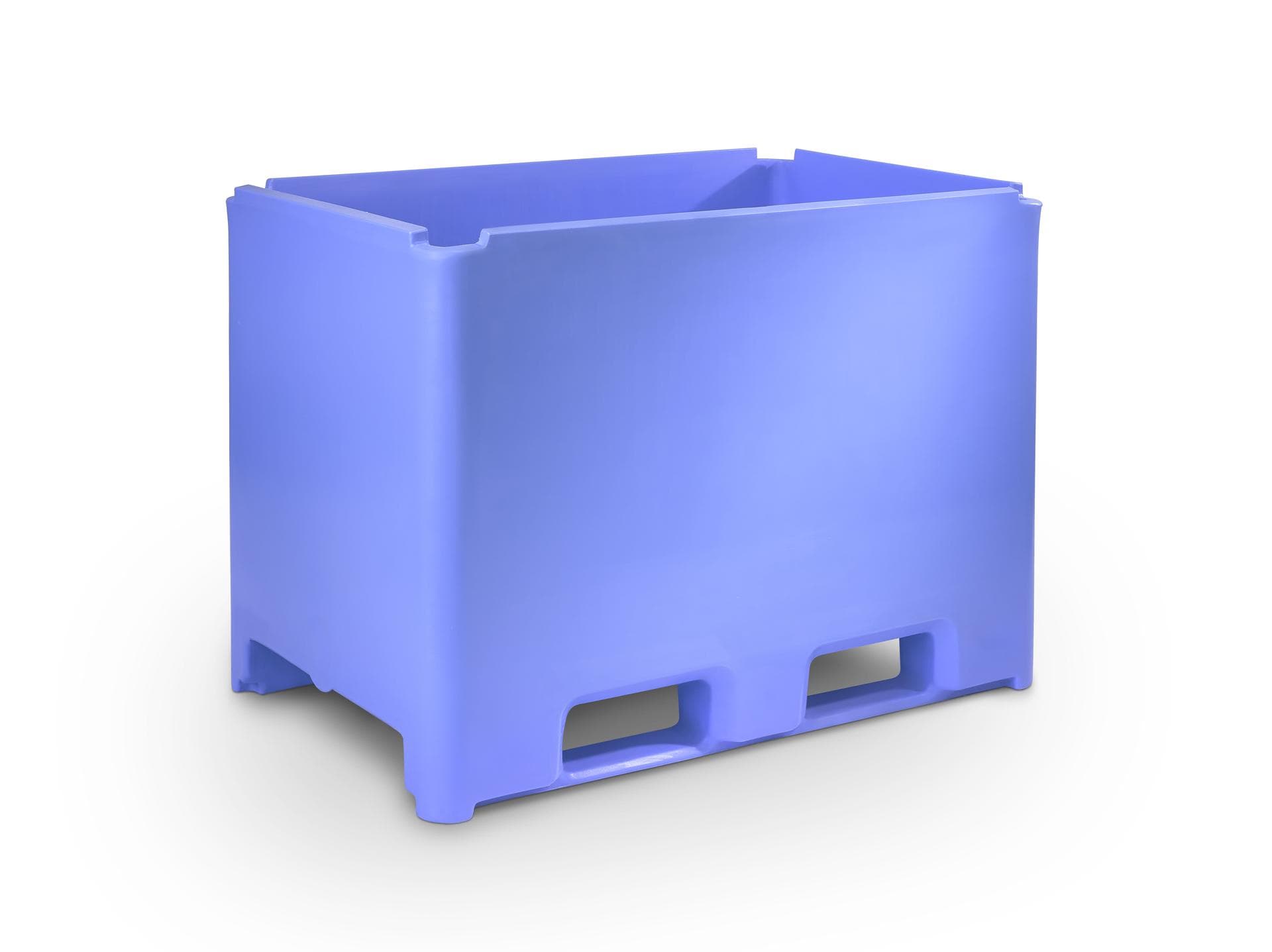
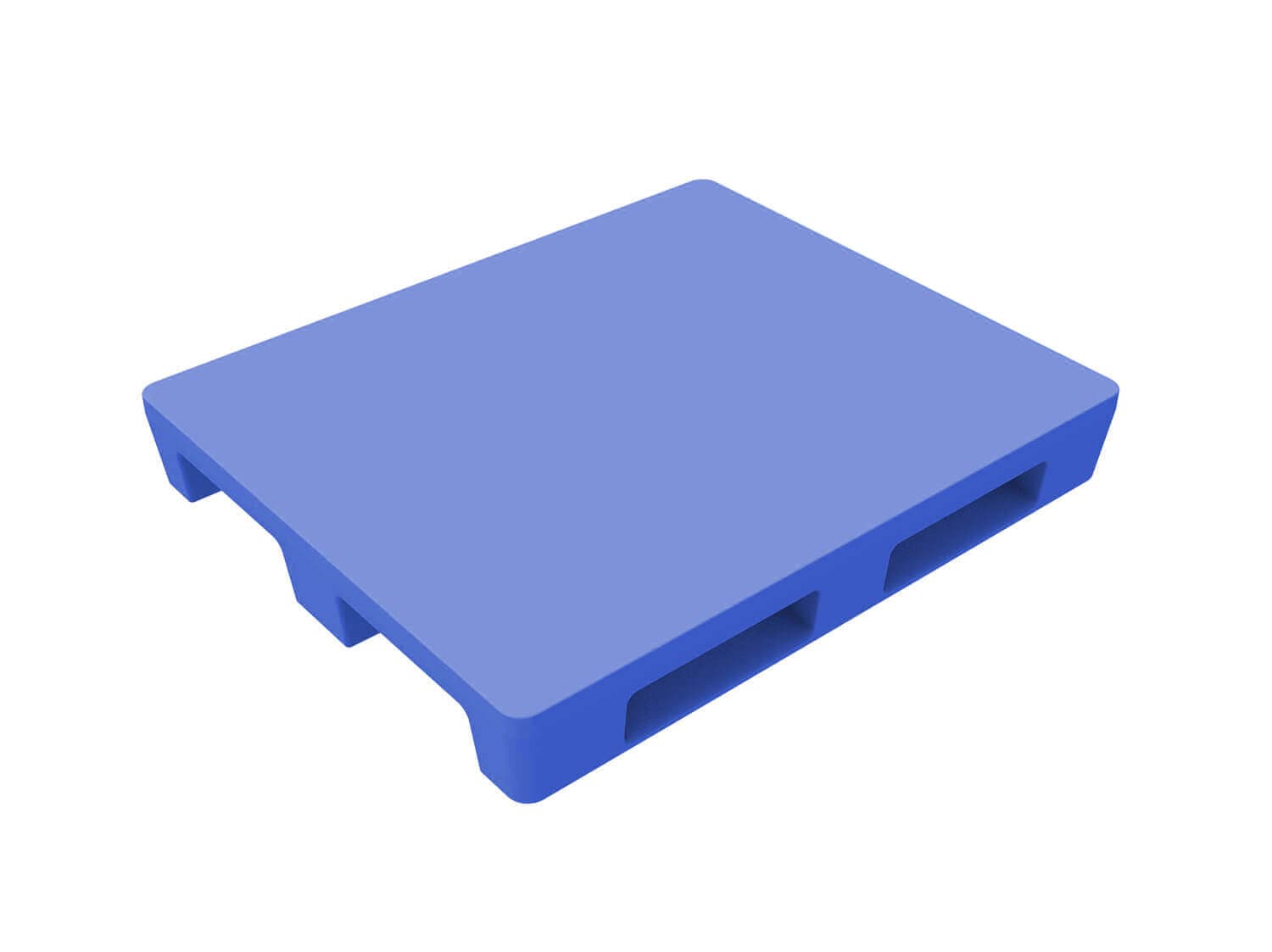
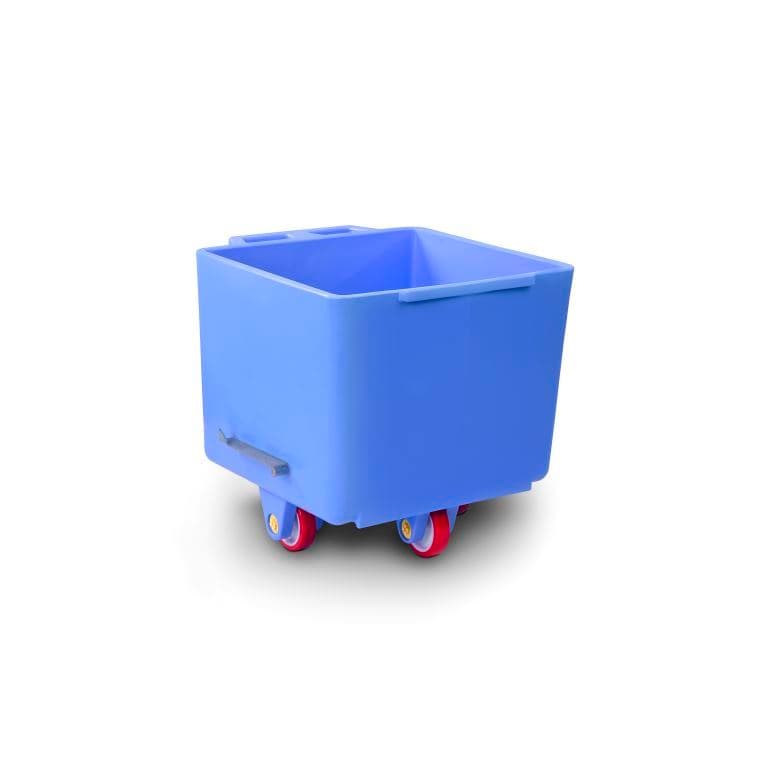
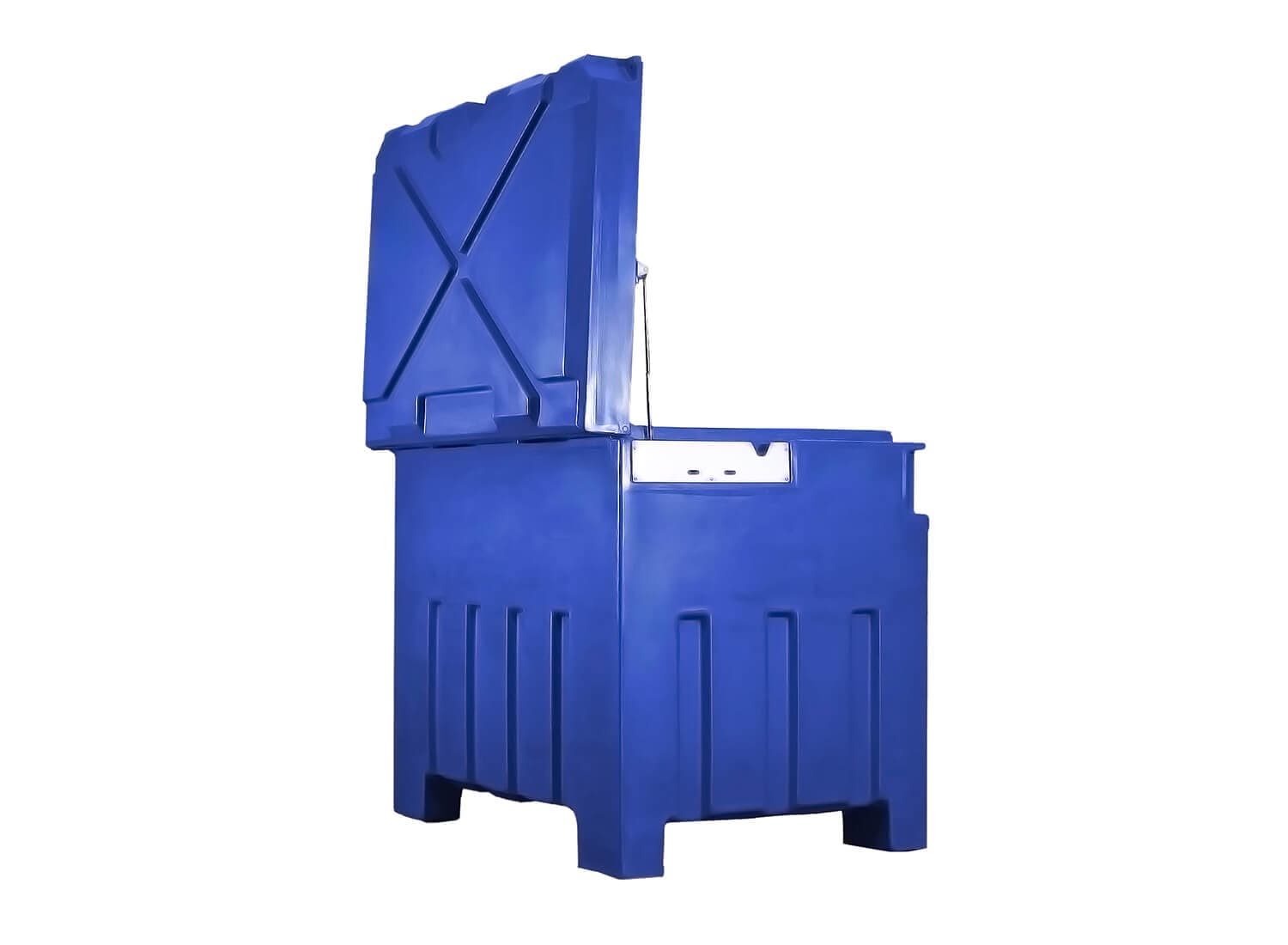
Matching products
Frequently asked questions
Are Rotogal containers approved for direct food contact?
Yes. All contact surfaces are food-grade polyethylene and comply with EU 1935/2004, EU 10/2011 and FDA 21 CFR 177.1520. Declarations of conformity and migration reports are available on request.
How do the containers behave under CIP and high-pressure cleaning?
The smooth, seam-free surface allows high-pressure cleaning up to 150 bar and hot water up to 80 °C. For CIP installations we offer geometries with drainage slopes and standardised cleaning connections.
Which colours and markings are possible for HACCP zoning?
Our standard colour is blue — classic and detectable for food applications. Custom colours, in-mould RFID tags and embedded barcodes enable zoned batch tracking without stick-on labels.
What minimum order applies for special colours or custom markings?
For standard items in standard colour we deliver from 1 unit. For custom colours the practical minimum is around 50 containers — we advise on material batches and cost optimisation per project.
How long do your containers really last in 3-shift hygiene operation?
In continuous 3-shift operation with high-pressure cleaning after every shift we reach 10–15 years of service life. Key factors are wall thickness, material (LMDPE, XLPE) and mechanical handling quality on site. We provide project-specific durability references.
Can I reorder containers as spare parts even years later?
Yes. We retain tools and specifications indefinitely and deliver reorders within our standard 4–6 week lead time — even 10 years after the first order. That applies to series items as well as custom articles.
How sustainable are your PE containers at end of life?
Our containers are made of single-polymer polyethylene and are 100 % materially recyclable. Within our take-back system we feed the material into new production — with a documented CO₂ balance that, across the full life cycle, often beats wooden and stainless-steel alternatives.
More industries
Please note: All information on this page – in particular dimensions, technical data, material properties and application recommendations – is provided for general guidance only and is non-binding. The exact specifications tailored to your specific application are agreed on a binding basis as part of the quotation and order process.
Got a project?
Tell us about your requirement — we typically come back with a first assessment within 24 hours.